“How Dye Do Neighbour”: William and Catherine Blake in Their Immediate Social Context, South Molton Street, Mayfair, c. 1803–21
Angus Whitehead (richard.whitehead@nie.edu.sg) is a lecturer in English literature at the National Institute of Education, Nanyang Technological University, Singapore. His most recent publication pertaining to William and Catherine Blake is “‘My Fingers Emit Sparks of Fire’: William Blake, Letter Writer” in William Blake’s Manuscripts: Praxis, Puzzles, and Palimpsests, edited by Mark Crosby and Josephine A. McQuail (Palgrave Macmillan, 2024). He is currently increasingly anxious about the fate of William Blake’s sole surviving London residence, 17 South Molton Street, as the whole street undergoes a swath of aggressive gentrification and development.
In the autumn of 1803,My great thanks to Catherine Kelly, Keri Davies, and Stephen Gamble for their vital help with this article, and my profound gratitude to Sarah Jones, who for the last twenty-two years or more has consistently helped make my Blake contributions miles better in both content and form. William and Catherine Blake returned to London from their three-year sojourn in a cottage in the coastal village of Felpham, Sussex. After an initial stay with Blake’s brother James at 28 Broad Street, and certainly by November, they had moved into a studio-residence at 17 South Molton Street, a street branching diagonally off the southern side of the northern end of Oxford Street (BR[2] 748). The new lodgings set them at the heart of art and art patronage in Regency London. From South Molton Street they were within easy walking distance of numerous galleries, as well as artists’ studios, shops, and collections. While Alexander Gilchrist describes the street during this period as “dingy, gardenless” (291), the Blakes had chosen a residence at the very center of London.
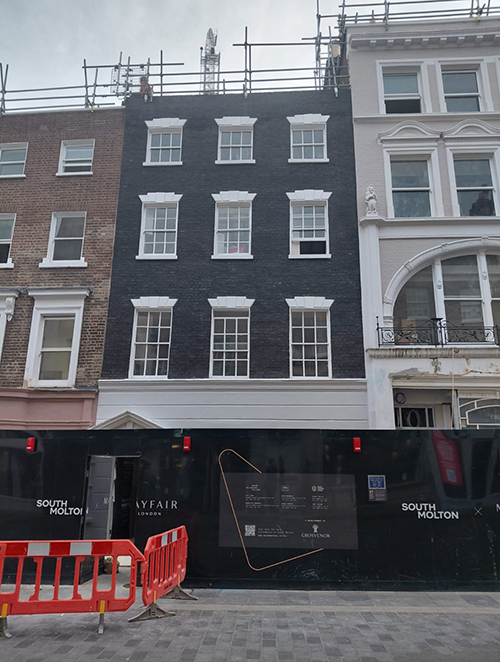
© Catherine Kelly, William Blake Fellowship.
1. The Surrounding Neighborhood
To the north of South Molton Street, Oxford Street, the main thoroughfare across London, included such fashionable spaces as the Argyll Rooms in nearby Argyll Street and on Oxford Street itself the Pantheon, a major exhibition space. Immediately to the east were Hanover Square, Hanover Music Rooms, and the preeminent promenade and shopping center of New Bond Street; to the west was Grosvenor Square, the location of connoisseur Sir George Beaumont’s painting room (Owen and Blayney Brown; BR[2] 703). Nonetheless, poverty was also in evidence, contrasting with otherwise affluent Mayfair: there was a large workhouse nearby at Mount Street, capable of accommodating seven hundred inhabitants.
Lower Brook Street was to the south of South Molton Street. Here the painter and pioneer lithographer Thomas Barker had his large exhibition rooms (Sloman, “Barker”). 20 Lower Brook Street was the former home of the miniaturist Alexander Day, who had exhibited and sold twenty-nine masterpieces by Raphael, Titian, Michelangelo, and other artists here in 1801 (Ingamells). Four years later, from February 1805, the landscape painter Francis Towne held his one-man exhibition of watercolors at the same address (Wilcox; Towne).
On the northern side of Oxford Street, directly opposite the northern opening of South Molton Street, was Stratford Place, a gated cul-de-sac in Blake’s time. The miniaturist Richard Cosway, Blake’s friend and supporter, lived here from 1794 until shortly before his death in July 1821 (Lloyd). At the center of Stratford Place stood the Earl of Aldborough’s naval pillar, celebrating Britain’s military triumphs. Erected in 1800, it was over twenty feet high and surmounted by a statue of George III. In 1805, however, the foundations of Aldborough’s ill-favored and apparently unpopular monument gave way; the column was removed and seemingly not replaced. Nevertheless, during their first eighteen months in South Molton Street, the Blakes would have regularly encountered this imposing but increasingly shabby and graffiti-covered structure, such as when Blake set out on errands of biographical research for William Hayley’s biography of the painter George Romney. Despite its defacement, he may have been able to make out the following: Sacred to British glory and the heroes / of its empire: / who, aided by the Almighty, / have carried their victorious arms / throughout every region / of the earth; / liberating mankind from the Atheistical principles, / unjust usurpations, / and tyrannical subjugation, / of rapacious France; / restoring due subordination, felicity and, / civilization, throughout / Europe.… In memory of the achievements of Admirals / Lords Hawke, Rodney, Howe, Hood, / Bridport, St. Vincent, Nelson, Duncan, / Sir John Borlase Warren, / Sir Sidney Smith, and Mitchell, / who in different actions with the / Spanish, French and Dutch, / took the Admirals of each nation; / captured, sunk and destroyed, / above one thousand of their ships; / annihilating their fleets and Commerce, / and ascertained and maintained, / under the Divine Providence, / the empire of Great Britain over the / Globe. (Malcolm) Aldborough’s short-lived monument and the sentiments presumably penned by his lordship and carved on its base may also have suggested themselves to Blake as he painted his not uncritical representations of war and Britain governing the nations in The Spiritual Form of Nelson Guiding Leviathan (c. 1805–09)—where an aroused, enraptured, and (but for sheepswool briefs) near-naked Nelson poses on conquered peoples of color while seemingly admiring, caressing, and guiding the destructive sea serpent—and in The Spiritual Form of Pitt Guiding Behemoth (1805?).
Half a mile from the northern end of South Molton Street as it meets Oxford Street, formerly Tyburn Road, was the site of the old Tyburn gallows, the principal place of execution in London from 1388. Blake may have recalled witnessing one of the last public executions enacted here before hangings were removed to Newgate in 1783, that of William Wynn Ryland, the engraving master Blake rejected in favor of James Basire in 1772, hanged for forgery on 29 August 1783 (Gilchrist 13).The day of the execution of Ryland and four other convicts would have been a public holiday.
2. The Street
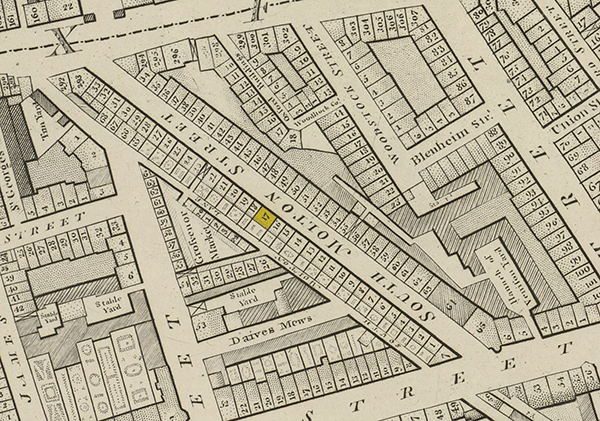
South Molton Street is in the parish of St. George, Hanover Square, Westminster. The name derives from its former title of South Moulton Row, which in turn has its origin in the Devonshire borough and market town of South Molton. The town experienced great economic prosperity through the wool trade in the mid-eighteenth century, the period of the street’s construction. South Molton Street was built at an oblique angle between Oxford and Brook Streets, following the course of a section of a tributary of the Westbourne River, Tyburn Brook. Culverted fifty years before the Blakes’ arrival, this part of the brook flows under South Molton Lane (formerly Poverty Lane), directly behind the southwestern side of South Molton Street (to the rear of no. 17), and continues south under Brook Street and Avery Row. This section of the Tyburn forms the western perimeter of the Corporation of London’s Conduit Mead Estate.For a map of the Conduit Mead Estate in 1794, see upload.wikimedia.org/wikipedia/commons/8/84/Conduit_Mead_Estate_1794.png. It has previously been assumed that Blake’s seven mentions of “Tyburns brook” in The Four Zoas, Milton, and Jerusalem refer to the stream near the site of execution at Tyburn. By alluding specifically to Tyburn Brook, however, he appears to be referencing the fact that the stream flows from Tyburn gallows and west to Hyde Park, via the rear of the western side of South Molton Street, underground beneath the rear windows of the Blakes’ residence. Thus these repeated references to Tyburn seem to have an immediate domestic biographical and topographical context.Blake’s occasional indulgence in superstitious practices is documented in his Notebook, in which it is recounted that he and Catherine practiced fortune-telling in August 1807. Catherine “was told by a Spirit to look for her fortune by opening by chance a book which she had in her hand it was [Edward] Bysshes Art of [English] Poetry” (E 696). Blake may also have recollected an ancient superstition concerning ghosts living by or in running water, which they cannot actually cross. According to this belief, the spirits of those sacrificed or executed at Tyburn would haunt stretches of Tyburn Brook. South Molton Street could be entered and exited on the southwestern side through a narrow passageway between nos. 22 and 23 that led to South Molton Lane. On the opposite side of the street was a passageway between nos. 55 and 56 that ran into Haunch of Venison Yard, a long yard leading south to Brook Street.
Evidence suggests that the original houses of which South Molton Street is composed were constructed between 1720 and 1760. A fireplate installed in the back of the fireplace of the front room on the second floor of no. 17 bears the date 1724.The fireplace and other details of the residence were examined with the assistance of Tim Heath, 15 June 2005. The street must have actually been built around 1750, however (London Encyclopaedia 821). John Rocque’s Plan of the Cities of London and Westminster, published in 1746, indicates that the northern half was formerly known as South Moulton Row. The southern half was called Paradise Row. Close examination of the map shows that between 1738 and 1745 houses appear to have been built on both sides of Paradise Row and on the northeastern side of South Moulton Row. The site on which no. 17 is now built, originally the southern end of the southwestern side of South Moulton Row, reveals no houses but a line of trees. Rate book records provide evidence of South Moulton Row (first rated in 1741) comprising ten properties in 1750.See the 31 May and 12 December 1750 rate books for St. George, Hanover Square, Brook Street Ward (City of Westminster Archives Centre [hereafter COWAC] C 285, 286). 1750 is also the date of the act of parliament that allowed for the section of Tyburn Brook that flowed near the southwestern side of South Moulton Row to be covered by a culvert.The culverting of this section of the Tyburn also formed South Molton Lane. See Barton 31. This enabled the building of houses on the southwestern side to take place, as well as the consequent development of what would become South Molton Street. We may therefore posit a date for the building of the section of South Molton Street of which no. 17 is part as between 1751 and the earliest traced reference to South Molton Street in a rate book, c. 1755.See St. George, Hanover Square, Poor, Highway, and Scavenger Rates, 1755, COWAC C 326.
By 1803 there were sixty-four residences surrounding the Blakes in South Molton Street. On their side, the houses were numbered 1 at the southern end to 33 in the north. On the eastern side, the numbers ran from 34 at the northern end to 65 in the south. An examination of poll books, trade directories, rate books, and the court records of the Old Bailey of the period have provided material for a comprehensive and systematic reconstruction of who lived in the street at the same time as the Blakes. The sources reveal forty-six private households and over fifty different trades (see table 1). These establishments included a private ladies’ school, a merchant, five coal merchants, possibly as many as three public houses, a watch and clockmaker, a surgeon, apothecary, and man midwife, a turnery warehouse and sieve maker, a brushmaker, a hotelier, two plumbers, an engine manufacturer, an ironmonger, five bakers, three tea dealers and grocers, two greengrocers, three fruiterers, two cheesemongers, a hatter, a straw-hat manufacturer, three saddlers, a hosier and glover, a music teacher, a cabinet maker, a calenderer and muslin cleaner, a wine cooper, two carpenters, a boot and shoemaker, a habit maker, a carriage-lamp manufacturer, an embroiderer, a broker and upholsterer, three conveyancers and attorneys, a confectioner, a plasterer, a tax officer, two breeches and gaiter makers, a hardwareman and cutler, an attorney and notary public, a wax and tallow chandler and soap manufacturer, a muslin cleaner, two carvers and gilders, two staymakers, four painters and glaziers, a builder, three upholsterers and undertakers, one china and Staffordshire warehouse, a hat manufacturer, a ladies’ shoemaker, several wine and brandy merchants, seven perfumers and hairdressers, and eighteen tailors.
Less is known of the members of the gentry who lived there. Former residents included “William Green of South Molton Street,” who in 1778 had published Description and Use of the Improved Reflecting and Refracting Telescopes, and Scale for Surveying, etc., and Samuel Martin, MP for Camelford (1747–68) and Hastings (1768–74), who fought a duel with John Wilkes in 1763 (Schaw 259; Martin). During the period of the Blakes’ residence there was the family of William Delane (1793–1857), future barrister and treasurer of The Times (Hamilton), and the ratepayers and residents who are listed with the title of “Gentleman” in the Westminster Poll Book for 1818: John Perret [sic], owner-manager of Perott’s Hotel; Charles Mence, conveyancer of the firm C. and W. Mence at no. 19; Stephen Stubbs at no. 47; and James Ruth at no. 53. Edward Jackson, who described himself as “R[oyal]. Artillery” and was presumably an army officer, was at no. 50. Radical MP for the City of London, former mayor of London, campaigner for Catholic emancipation, and chief supporter of Queen Caroline,Blake’s engraving of “Mrs. Q,” George IV’s former mistress, was published (1 June 1820) on the eve of Caroline’s return from exile. Alderman Matthew Wood, occupied a house in South Molton Street.At the trial of Edward Felton for theft on 21 April 1819, Wood testified that he lived there (Proceedings of the Old Bailey [hereafter POB], ref. t18190421-33).For crime in the street during the Blakes’ time, see Whitehead, “Reconstructing” 66, 75n148. At least in the autumn of 1811, the street appears to have had its own watchman, Joseph Wakeman, on patrol at 4:00 a.m. and presumably through the night (see POB, ref. t18111030-83).
Near Neighbors
Between 1804 and 1808 the ratepayer and principal occupant at no. 16 was the attorney John Griffin. A merchant, John Johnson, occupied the property with Griffin; Johnson became the ratepayer when Griffin left in 1809 and continued until 1813. He and his wife, Ann, kept a coal warehouse at the property (POB, ref. t17991030-79), one of five such establishments in the street during this period.From 1812 John Wilson ran a coal merchant’s from no. 14; George Parvin, coal merchant, conducted business at no. 21. When the Johnsons departed, Archibald Newland, tailor, occupied and ran his business from the property between 1814 and 1821. The history of no. 16 at this time is typical of a number of South Molton Street residences in which occupants and tradesmen arrived and departed with relative rapidity.
In contrast, the Blakes’ other immediate neighbor stayed for the duration of their residence and remained long afterwards. No. 18 was the premises of Francis Tucker, wax and tallow chandler and soap merchant. Although Tucker himself died in 1850, his family business, which employed a number of staff, remained at this address from almost a decade before the Blakes’ arrival until nearly a century after their departure. The shop must have been a useful source of candles for illuminating the Blakes’ rooms and also for soap for washing their clothes and persons. According to a reminiscence attributed to George Richmond, “Once Mrs Blake, in excuse for the general lack of soap and water, remarked to me: ‘You see, Mr. Blake’s skin don’t dirt!,’”BR(2) 404. Bentley notes that “the chain of evidence for this story is … long and fragile” (BR[2] 868n59).Between 1813 and 1815 George Cumberland and George Cumberland, Jr., both made reference to the Blakes’ appearing dirty (BR[2] 316, 320). On one occasion, however, Cumberland wrote that his old friend Thomas Stothard was dirtier than the Blakes (BR[2] 316). Perhaps the “dirt” could be attributed to the painting media and printer’s ink that both artists utilized. but Tucker’s presence may indicate that soap and water were present, even if not necessarily in evidence to those who visited the Blakes. Tucker, a devout Catholic, enjoyed royal patronage for his soap and candles, perhaps suggesting more of a luxury goods establishment.According to his will, Tucker died a wealthy man, leaving several properties, including no. 18, to his children, and significant sums to numerous London Catholic charities and foundations (PRO PROB 11/2109).
No. 50, opposite no. 17, was the residence of William and Isabella Spratt and their lodger, a dissenting clergyman, Rev. Thomas Nicholas (1805–08). Marsha Keith Schuchard claims that Richard Cosway kept a house at no. 51 “for the study of magic,”Schuchard 318. Schuchard cites Gerald Barnett’s Richard and Maria Cosway: A Biography (1995), but may be referring to George Cumberland’s copy books. She gives little sense of when Cosway may have utilized no. 51; as mentioned above, his actual residence was across Oxford Street, at Stratford Place. but local rate books and directories reveal a different owner and business, Charles King’s turnery warehouse, where King and his staff produced ornamental objects on pedal-powered lathes.In 1813 this was the residence of George Cumberland’s friend Dayley (see BR[2] 316).Cumberland appears to have regularly visited and lodged with the barrister and art collector George Townley, who had chambers at no. 61 (see Whitehead, “Pocketbooks”).
One hundred yards from the back of no. 17 was the small, triangular Grosvenor Market, still operating though slowly failing and increasingly deserted owing to the larger, more central St. George’s Market. From their back room where they relaxed and slept William and Catherine Blake could have seen and heard butchers, poulterers, fishmongers, butter men, cheesemongers, and other traders plying their respective trades out of doors and on their stalls to neighborhood customers. Did the now middle-aged couple empathize with this obscure and—in Blake’s words from The Four Zoas—“desolate market” (E 325) where steadily fewer customers than expected came to buy?
Prostitutes
In the 1794 edition of rake and poet Samuel Derrick’s directory of middle-class prostitutes, Harris’s List of Covent-Garden Ladies, three are listed in houses near the southeastern corner of the street. The 1793 edition also includes “Miſs Gronmoſ—d” at no. 59; “Miſs Wa—s” at no. 60, who “drives a chariot, has ſeveral city friends, both bankers and Iſraelites”; and “Miſs Br—ley” at no. 61 (30-31, 43-44, 22-23). None of the ratepayers of these properties in 1793 appears to have remained in South Molton Street in 1803. Some of Blake’s neighbors, however, such as James Mivart, Margaret Vaynall, William Goodchild, John Pool, George Parvin, William Thackray, Archibald Hay, William Thorogood, William Heron, and William Sloper, would probably have remembered these former residents. In the 1788 edition of Harris there is an entry for “Miss G—rge, at a Grocer’s Shop, South-Molton Street” (41-42). In the 1793 edition a Miss G—rge, living at no. 13, “drives a very handsome curricle, and is in keeping by a Mr. C—ns” (49-50). However, the “Grocer’s” may have been no. 32, the premises of John Richardson, tea dealer and grocer, who was still in business at this address when the Blakes arrived. The 1790 edition of Harris contains an entry for “Miss Williams, 32 South Molton Street, Grosvenor Square” (113). To my query concerning the likelihood of prostitutes still residing in South Molton Street in 1803, Hallie Rubenhold, an authority on Harris’s List, replied: The chances of prostitutes still living on South Molton Street by the early 19th century was certainly very high … prostitutes were integrated into ordinary (or so called respectable) areas. There were no red light districts and this continued to be the case into the early 19th century.… But one caveat must be added; the women listed in the later Harris’s Lists … were outwardly quite respectable … and wouldn’t have solicited on the street. On South Molton Street they would not have been “top end” prostitutes either—rather, just middle class girls. (Private correspondence, 27 February 2006) The fact that several prostitutes, advertised in an apparently widely circulated publication, lived in the street may explain a reference in playwright and poet Hannah Cowley’s popular play of 1781, The Belle’s Stratagem. In act 3, scene 1, the heroine, Letitia Hardy, informs Mrs. Racket: You may tell the gentleman what a genius I have; how I can cut watch-papers, work cat-gut, make quadril baskets with pins, and take profiles in shades; ay, as well as the lady at No. 62, South Molton-street, Grosvenor-square.It is of course also possible that Cowley is referring to a female profilist residing at this address c. 1780.
Printers and Booksellers
At no. 7, the premises of Brown and Scripps, newsmen and stationers, Blake could have read and acquired books, as well as paper for printing, pencils, brushes, and other art materials.See Pigot’s London and Provincial New Commercial Directory, 1823–4 (1823) 45, 47. William Armiger Scripps was publisher (1801–20) of a prominent London newspaper, the London Daily Sun, then of the Literary Gazette, which was the first to print a sustained obituary of the poet-artist (BR[2] 465-67). The shop may therefore have been a conduit through which Blake learned of current events, from heightened fears of Napoleonic invasion in 1803 to the discovery of the Cato Street Conspiracy in February 1820.
Significant for Blake in the months leading up to his 1809–10 exhibition at 28 Broad Street was the printing and bookselling firm of Ann Watts and Edward Bridgewater, based at no. 31, which “printed the advertisements for Blake’s Descriptive Catalogue (1809) and ‘Blake’s Chaucer: The Canterbury Pilgrims’ (1809), while Watts & Co. printed his ‘Exhibition of Paintings in Fresco’ (1809)” (Bentley, Stranger 260n). These advertisements were perhaps displayed in the bookshop on the same premises. According to Ian Maxted, The London Book Trades, 1775–1800, Clement Watts had begun trading at 9 Queen Street, Grosvenor Square, c. 1774; the firm continued under the name Ann Watts in 1785 and Watts and Bridgewater in 1799. Watts and Bridgewater relocated to 31 South Molton Street c. 1807, approximately three years after the arrival of the Blakes. From 1817 it did business under the name Edward Bridgewater.Bridgewater may have been the author of a children’s book, E. B. [Edward Bridgewater?], New and Instructive Moral Tales (1802). In 1807 it registered its presses.See Maxted 240. I have traced one publication that involved art prints: Drawings from Original Pictures of Philip Reinagle—by an Amateur—Folio—8 Lithographic Plates (c. 1826). If one of the presses registered at no. 31 in 1807 was a new lithographic press, perhaps Blake’s “Enoch” was printed there.
The business published a number of works for the evangelical hymn-writer Basil Woodd, minister of Bentick Chapel, Marylebone, including:
- The Psalms of David and Other Portions of the Sacred Scriptures, Arranged according to the Order of the Church of England (1795);
- Memoirs of Mrs. Hannah Woodd, 3rd ed. (1799), an account of his late mother in the form of a letter addressed to the prominent evangelical minister Richard Conyers, an associate of William Cowper and Mary Unwin, George Whitefield and John Wesley (see Cowie);
- A Brief Exploration of the Church Catechism, 11th ed. (c. 1805);
- Advice to Youth Principally Designed for Young People Leaving School (1806);
- The Excellence of the Liturgy: A Sermon, Preached in the Parish Church of St. Mary, Aylesbury, at the Visitation of the Archdeacon of Bucks. on Wednesday, June 27, 1810 (1810). G. W. O. Addleshaw has described the sermon as “of some importance as it reinterpreted the principles of the classical liturgists for the Evangelical party” (145);
- A Memoir of Bowyer Smith, a Pious Child (1812), which may have shared similarities with Benjamin Heath Malkin’s A Father’s Memoirs of His Child, another work of infant hagiography;
- The Two Grand Instruments for the Propagation of the Gospel, and the Duty of Christians to Uphold Them with Zeal and Energy (1816); and
- A New Metrical Version of the Psalms of David (1821).See Whitehead, New Discoveries 2: 258-59.The tension between religious enthusiasm and a desire to revive traditional liturgy in some quarters of early nineteenth-century evangelical Christianity, evident in Woodd’s publications and ministry, can also be traced in the early history of the Catholic Apostolic (“Irvingite”) Church, which Blake’s disciple Frederick Tatham became fervently involved with from sometime between c. 1824 and 1831 and his death in 1878. The same tension might also be evident in Blake’s decision to be buried at Bunhill Fields, a dissenter’s burial ground, “but as to service, he should wish for that of the Church of England” (BR[2] 625-26).
Other books and pamphlets produced by the firm were:
- E. Warren, The Poet’s Day, or Imagination’s Ramble. A Poem in Four Books, with Some Smaller Pieces (1803);
- Select Psalmody for the Use of the Free Chapel in West-Street, St. Giles’s (1805);
- F[rederick]. A[lbert]. Winsor, A National Light and Heat Company [based at 97 Pall Mall], for Providing Our Streets and Houses with Hydrocarbonic Gas-Lights, on Similar Principles, as They Are Now Supplied with Water (1805);Although publicly ridiculed by such well-known public figures as Walter Scott and Humphry Davy, Winsor’s prospectus led to widespread gas lighting in the metropolis by 1815 (Williams).
- Richard Du Bourg, Descriptive Catalogue of Du Bourg’s Museum, No. 68, Lower Grosvenor-Street … Large Models Made of Cork, Done by Scale, Representing Some of the Most Superb Remains of Roman Magnificence, in and near Rome, Naples, Verona and the South of France (1810);
- William Howard, A Letter to Joanna Southcott, the Pretended Prophetess, with a Fac-simile of Her Handwriting as Connected with Her Blasphemous Seal (1810); and
- The biography by James Forbes (author, traveler, and pioneering collector of Hindu scriptures and representations of deities) of his sister, Ricordanza: Memoir of Elizabeth Dalton (1813).
Further Residents and Establishments of Note
At no. 54 was Mrs. Kelly’s ladies’ school. As Mrs. Kelly is not listed as a ratepayer, she probably lodged and ran her school from one or two floors of the house. It seems unlikely that any pupils would have boarded with her. She may have given lessons on Saturday mornings, as Sarah Malin did at her school at 54 Newgate Street in 1802 (POB, ref. t18021027-10).The Blakes’ friend Elizabeth Butts, wife of Blake’s patron Thomas Butts, ran a girls’ school at nearby 9 Great Marlborough Street, which Blake’s numerous biblical paintings commissioned by Thomas Butts appear to have decorated. Blake may even have taught at Mrs. Butts’s school. See Viscomi; BR[2] 90. Also on the other side from no. 17, but in the opposite direction, the Bricklayer’s Arms at no. 46 was run by a series of landlords during the Blakes’ period of residence (COWAC C 606-09; Westminster Poll Book for 1818, p. 52). The name of this pub must be connected with those workmen carrying out plans for the rapid expansion of London in this area, c. 1750–1830. It may also provide a possible context for lines in Jerusalem: “What are those golden Builders doing / Near mournful ever-weeping Paddington” (E 172). The Proceedings of the Old Bailey for 1811 suggest that this popular pub was used by local thieves to share out loot and fence items (POB, ref. t18111030-74). According to Gilchrist, when Blake later lodged in Fountain Court, he “fetched the porter for dinner himself, from the house at the corner of the Strand” (313).Gilchrist continues, “It was only in later years [that Blake] took porter regularly. He then fancied it soothed him, and would sit and muse over his pint after a one o’clock dinner.” The house at the corner of the Strand was almost certainly the Coal Hole tavern, the rear of which was almost opposite the Blakes’ lodgings at no. 3 Fountain Court. It seems likely that a few years earlier Blake would have started the habit of regularly visiting the Bricklayer’s Arms for similar reasons. From 1812, William Goslett ran a carving and gilding and presumably picture-framing business at no. 32. Goslett may have been one of several carvers and gilders who supplied Blake with small amounts of gold leaf at a period in which he regularly incorporated metals into the creation of his temperas, watercolors, and illuminated books.Whitehead, “Gold and Silver” 92.
At no. 11 was the Land and Assessed Taxes office for the parish of St. George, Hanover Square, managed by Edmund Treherne, clerk, resident, and ratepayer for the property. Treherne had been appointed head clerk in 1801.See the suicide notice for his son, also Edmund, in The Times of 31 March 1863, p. 12. Contemporary rate books and trade directories indicate that a Thomas Hattersley, fruiterer and greengrocer, resided and conducted his business at no. 4 between 1803 and 1816. By 1821 Robert Hattersley, presumably Thomas’s son, had succeeded him as ratepayer. Thomas and Robert Hattersley may have been related to Joshua Hattersley, who married Grace Armitage, sister of Thomas Armitage, the first husband of Blake’s mother, Catherine Wright.See BR(2) xxxii. I am grateful to Keri Davies for this suggestion.
It may be significant that members of at least one household in South Molton Street had, like the Blakes, previously associated with the Swedenborgian Church. On 14 June 1795 Joseph and Sarah Evans’s fourth daughter, Mary, was baptised at the New Jerusalemite Church, Friar Street, Blackfriars.See FamilySearch, www.familysearch.org. The fact that the Evanses had their daughter baptised there suggests that they had previously joined the church. Their connection with the church seems, again like the Blakes’, to have been comparatively brief. Their eldest son, Joseph, was baptised at the parish church, St. George’s, Hanover Square, on 26 October 1794, and their last child, Sarah, was baptised at the same church on 7 April 1799. The Blakes appear never to have actually joined the New Church (BR[2] 53). In 1803 Joseph and Sarah (née Hearl) resided at no. 45 (COWAC C 596). Joseph appears to have been a partner in the firm Evans and Cutler, tailors and drapers, who traded at no. 56, the residence of Edward Cutler. Between 1809 and 1821 Evans’s widow remained at no. 45.
Artists
Despite a popular misconception that the Blakes lived in relative isolation during the first fourteen years they resided in South Molton Street,That is, before Blake’s meeting with John Linnell, c. June 1818. there is clear evidence, even among the relatively few surviving accounts of the period, that they encountered and conversed with numerous friends and acquaintances. Among them were several artists. As we have seen, Richard Cosway, whom Blake had first met in the 1780s, lived in Stratford Place. Formerly, South Molton Street had been home to other artists. John Claude Nattes, topographical draftsman, watercolor artist, and cofounder of the Society of Painters in Water Colours, had resided at no. 49 in the 1790s (Flood; Graves 5: 344). Elizabeth Sarah Villa-Real Gooch, courtesan, poet, and novelist, had written her sensational autobiography The Life of Mrs. Gooch (1792) from her rooms at no. 13 (Gooch 2: 139), and may still have been resident when the Blakes arrived.
Blake’s letter to Hayley dated 28 September 1804 suggests more than a passing acquaintance with “Mr Spilsbury” (E 755), almost certainly Jonathan Spilsbury (1737–1812), painter, engraver, printmaker, and member of the Moravian Church.An identification first suggested by Archibald Russell, who also notes that Spilsbury exhibited portraits at the Royal Academy from 1776 to 1807 (Blake, Letters 166n3). Between 1791 and his death, Spilsbury lived in St. George’s Row, off Oxford Street.See Sloman, “Spilsbury,” and also Spilsbury’s will (PRO PROB 11/1543). At least one younger artist, Martin Cregan, the student of Martin Archer Shee, visited the Blakes at South Molton Street.BR(2) 281. Cregan’s visit suggests parallels with the Ancients’ later visits to Fountain Court (see BR[2] 340-464). In addition, around 1812 Blake is likely to have met and conversed with fellow members of the Associated Painters in Water Colours (BR[2] 311-12).
Several other artists appear to have been close neighbors. As Bentley has observed, the Bristol artist and academician Edward Bird lived at no. 29 in 1818.BR(2) 748. Bird is listed at this address in the Royal Academy exhibition catalogue for 1818 (Graves 1: 200). Ten years earlier, an E. Bird of Bristol was a subscriber to Robert Blair’s The Grave, with designs by Blake (see Blair). The Royal Academy exhibition catalogues indicate that between 1811 and 1813 the miniature painter and engraver William Haines (1778–1848) resided and had his studio at no. 10 (Graves 3: 349). Haines, like Blake, engraved one of the twelve plates in Hayley’s The Life of George Romney, finally published in 1809 (Haines). From 1806 to 1814, the landscape and portrait painter J. E. H. Robinson lived and worked at no. 14, and in 1820 the landscape painter B. Rotch lived two doors from the Blakes.Graves 6: 338, 375. Rotch appears to have been succeeded by the portrait painter Edward Daniel Leahy, who was at no. 15 in 1821–22 (Graves 5: 12). The exhibition catalogues also record that from 1812 to 1816 William Fleetwood Varley (1785–1856), the landscape painter and brother of John and Cornelius Varley, lived at no. 45, next door to the Bricklayer’s Arms.Graves 8: 76. The rates for this property were paid by Joseph Evans’s widow, Sarah. William Varley, like the Blakes and other artists living in the street in this period, must therefore have been a lodger.
3. William Fleetwood Varley
Blake was an intimate friend of the watercolorist and astrologer John Varley. From 1818 until 1825, and probably up until Blake’s death in August 1827, the two regularly met. On at least one occasion Varley also assisted in promoting his friend’s work (BR[2] 385). Of particular significance are the Visionary Heads, the numerous portraits of historical or imaginary figures that Blake sketched with Varley’s encouragement and in his presence between c. 1819 and 1825.See Butlin p. 495. The Visionary Heads were drawn in three books: the Small Blake-Varley Sketchbook (discovered in 1967), the Large Blake-Varley Sketchbook (discovered in 1989), and the Folio Blake-Varley Sketchbook (untraced) (BR[2] 346-63). In his manuscript “Autobiography,” written in the 1850s and partially revised and expanded in the 1860s, John Linnell—Varley’s former pupil—claims to have introduced his new friend Blake to Varley: “John Varley[,] to whom I had introduced Blake & who readily devoured all the marvellous in Blake’s most extravagant utterances” (BR[2] 341). Most Blake biographers and scholars have accepted this account; for instance, Morton D. Paley asserts that “John Linnell had been a pupil of Varley’s and no doubt introduced him to Blake” (300). Yet Linnell’s version was written over forty years after the event that it purports to describe. Entries in his journal for 1818 refer to being together with Blake and Varley on three separate occasions in mid-September: “Sat 12 … Mr Blake Brought a proof of Mr Upton’s | Plate | … | Mr Varley—& Mr Constable stay’d with Blake”; “Friday 18 … to Mr Blake with Mr Varley—Evg—”; “Sat 19 … Dr Thornton called & Mr Blake | went with Mr Blake to Mr Varley’s Evg—” (BR[2] 343).
While establishing that the three artists regularly met at that time, these entries do not confirm Linnell’s later claim that he introduced Blake to Varley. Varley was fourteen years Linnell’s senior and had been exhibiting at the Royal Academy since 1798 (Graves 8: 75) and at the Society of Painters in Water Colours, which he cofounded in November 1804, since its first exhibition in 1805.The first exhibition of the Society of Painters in Water Colours in April 1805 was held, not in Pall Mall as asserted by Gilchrist (260), but at 20 Lower Brook Street, just around the corner from the Blakes’ apartment (see Kauffmann, John Varley 30). Both Blake and Varley contributed watercolors to Rev. Joseph Thomas’s second folio edition of Shakespeare.See Butlin #547. Other artists included John Flaxman and William Mulready. It is therefore curious that in what Bentley describes as “the tight little artistic world of [the] time” (BR[2] 227fn) it should have been the twenty-six-year-old Linnell who introduced Blake to the established painter Varley. Although there is no conclusive evidence, there were plentiful opportunities for the two to have crossed paths before 1818. Bentley has suggested that Linnell was the first member of the Ancients to meet Blake,BR(2) 340. However, in his biography of Blake, Bentley states: “Probably the first of the Ancients to meet Blake was Frederick Tatham, for his father, the architect and Baptist Charles Heathcote Tatham, had been a friend of Blake’s for many years” (Stranger 401). but a passage in Gilchrist intimates that Varley knew Blake before Linnell’s “introduction” and also that Francis Oliver Finch, another of Varley’s pupils and a future Ancient, knew of Blake and had probably met him before then: As a boy, [Finch] had heard again and again of Blake from John Varley, whose pupil he was for five years, and his imagination had been much excited by what he had heard. For once expectation was fulfilled. In Mr. Finch’s own felicitous words, Blake “struck him as a new kind of man, wholly original, and in all things.”Gilchrist 300. In a letter to Anne Gilchrist written several months after Finch’s death on 27 August 1862, Samuel Palmer describes him as a “very old friend of Blake” (Palmer 2: 674). Although Palmer was exaggerating, his comment suggests that Finch was one of the first Ancients to meet Blake. According to one of his fellow students, Finch was a pupil of Varley’s between 1814 and 1819 (Sharpe 323). It is therefore likely that the young Finch, sitting alongside John Sharpe and Henry Bryan Ziegler, first heard of Blake at Varley’s studio at 15 Broad Street, Carnaby Market, and it is possible that he met Blake before Linnell did.At the time of Blake’s one-man exhibition at 28 Broad Street, Varley resided thirteen doors away (see Kauffmann, John Varley 71). Varley himself may have encountered Blake sometime before 1814. It is therefore worth considering other avenues through which John Varley and William Blake could have known each other.
Keri Davies has proposed that Blake was acquainted with Varley’s paternal uncle, Samuel Varley (1744–1822)—lecturer on “Natural and Experimental Philosophy,” founder of the Chemical and Philosophical Society (forerunner of the Royal Institution), and scientific associate of Charles, third Earl Stanhope—as early as the 1780s. As he observes, “In the current biographical account John Varley comes from nowhere into William Blake’s life—bringing William Blake and Samuel Varley together in the 1780s makes Blake’s later friendship with John Varley more understandable.”See Davies 225-26, 232-33. He also argues that Samuel Varley is a likely model for Inflammable Gass the Wind Finder in An Island in the Moon. Three decades later, Blake may also have made the acquaintance of another member of the Varley family, prior to meeting either John Varley or Linnell.
John and Cornelius Varley are familiar names to scholars of art history and Blake, but their younger brother William is a largely forgotten figure. However, C. M. Kauffmann and Stephen Gamble have demonstrated that, until he was badly injured in a fire in Oxford sometime after 1825,Gamble (private correspondence, 20 October 2026) suggests that the fire could have been as late as 1841. William Fleetwood Varley was an accomplished painter and teacher (Kauffmann, “Varley, John”; Gamble 180-84). He introduced Linnell to his brother John; as Linnell recalls, “I became aquainted [sic] with John Varley through his brother William who saw me at Christie’s Auction Room sketching from a drawing by [Thomas?] Girton [sic]” (“Autobiography,” f. 4).The account is retold in Story 1: 19 and David Linnell 8. Firestone (7) dates this encounter to 1804. Linnell continues, “William had no talent and was the butt of the family.”Cited in Kauffmann, John Varley 63. Biographical evidence suggests that from the 1850s Linnell became both less charitable and less reliable as a historical source.See Firestone 47, 98, 188. On 23 August 1860 the art dealer L. V. Platow wrote to Linnell, “It is well that you know that you stand alone in the artistic world in your unprincipled mode of doing business” (Firestone 147n19). When he received the following letter from William at some point prior to August 1849—when William’s wife, Maria, died of cholera—Linnell was probably less sympathetic than he had been to William’s debt-plagued brother John twenty years earlier.See Firestone 69; David Linnell 100-01.
45 Upper Rathbone Place
Oxford Street—
Sir/
I have the honour to address you once more and I trust you will excuse it. I am with my wife and 7 children without Bread & are in the height of distress have been so for along [sic] time And my children are allmost starving I have no business and not a drawing by me and this last 3 weeks I have been obliged to go round to collect in a husle [haste?] to send for them & now we are all in 1 Room and not 1 Farthing to help us Mrs VarleyDelvalle, widow of John Varley and daughter of Wilson Lowry. cannot assist me or Cornelius and now you are a great Painter I venture to appeal to your Benevolence trusting in Providence to send me this year some Immediate Relief from our destitute and indigent state.
I have the honor to remain
In with the highest respect
Your most Obet Sevt
Wllm Fleetwood Varley
To John Linnell Esq.Linnell Papers, Fitzwilliam Museum, MS 2754-2000. A copy of this unpublished letter was kindly shown to me by Stephen Gamble.
Kauffmann, citing as evidence a manuscript artist’s manual entitled “Principles of Art by William Varley 1819,” disputes Linnell’s recollection of William’s lack of talent and asserts that he was “one of the more important [watercolor] teachers of his day.”Kauffmann, John Varley 64. Three years earlier, William had published a fifteen-page pamphlet entitled A Few Observations on Art with Notices Relevant to the Various Exhibitions, Repositories of Art, etc. (1816). Adrian Bury (66) erroneously ascribes the pamphlet to John Varley. While residing in South Molton Street, William would almost certainly have advertised for and taught numerous students.In the frontispiece to A Few Observations on Art, he describes himself as a Drawing Master … who instructs Ladies and Gentlemen to Draw with Taste, Accuracy, and Expedition, on the most approved Principles, and liberal Terms. Such Pupils as are intrusted [sic] to his care, are taught to Sketch from Nature, and every attention paid to accelerate their progress in Theory and Practice. … patronised by the nobility and gentry. Blake had also been employed as a teacher (Bentley, Stranger 288; BR[2] 222-23). As well as composing Jerusalem and engraving illustrations to Hesiod for John Flaxman and illustrations for Wedgwood’s catalogue at this time, Blake continued work on his watercolor illustrations to Milton. The fact that these two artists lived in such close proximity to one another for half a decade suggests a plausible avenue through which they may have become acquainted (Kauffmann, John Varley 63). Blake, then in his mid-fifties, and William Varley, in his late twenties, could have met as early as 1812, the year of the latter’s arrival in South Molton Street and six years before George Cumberland, Jr., introduced Blake to Linnell (BR[2] 340). In the opening months of 1812, both were preparing watercolors to be shown in forthcoming exhibitions (BR[2] 311-14; Graves 8: 76). It is also conceivable that John Varley, perhaps during a visit to his younger brother and family at no. 45, could have first encountered Blake sometime between 1812 and 1816. Such a possibility throws further doubt on the widely held assumption that Linnell was responsible for introducing Blake to John Varley, Finch, Palmer, and Tatham.See, for example, Story 1: 170-71; Vaughan 78; Lister, “Finch”; BR(2) 403. It also suggests that during the period of so-called “Independence and Obscurity,” 1806–18 (BR[2] 220), Blake may have established an important and productive relationship with a fellow artist and neighbor, William Varley.
There may be further links between Blake and William Varley. Raymond Lister states that Blake … was fond of experimenting, and it would not be uncharacteristic if he had experimented with varnish. The practice of varnishing water-colours, although never a common practice, arose in the eighteenth century, when they were often exhibited on the same wall as oil paintings, and were not always covered with glass. Among water-colourists who varnished their work was John Varley, who became a friend of Blake in his latter years. Blake might have seen examples so treated by Varley, and perhaps liking the immediate effect, used it himself. On the other hand, it does not, so far as we know, occur on water-colours painted after he had met Varley; so he might have applied varnish to earlier works by way of experiment and, not after all liking the effect, carried it no further. Or he might merely have adopted the practice from what was a general custom at the time. (Infernal Methods 45) Nonetheless, as Lister points out, “Blake also used varnish on some of his temperas” (46n26), including later works. On 1 and 4 August 1829, Catherine Blake wrote to her late husband’s patron George O’Brien Wyndham, third Earl of Egremont, about applying a third coat of “white hard Varnish” to a watercolor, The Characters in Spenser’s Faerie Queene, that he had recently purchased from her (BR[2] 498). In 1816, shortly after leaving South Molton Street, William Varley advertised for sale to the public “W.V.’s preparation for preserving Pencil Drawings, in bottles 3s. each.”See the title page of A Few Observations. Could Blake’s, and consequently Catherine’s, method of creating and applying varnish to watercolors have been influenced by conversations with William Varley, or indeed by their use or emulation of “W.V.’s preparation”?
William Mason, the printer of the second edition of William Varley’s impressive treatise on painting, Observations on Colouring and Sketching from Nature … Considerably Enlarged and Corrected (1820), would have been familiar with at least one of Blake’s commercial engravings: his print for Hayley’s Life of Romney. Mason became Hayley’s printer after the death of Joseph Seagrave in 1808, taking over Seagrave’s premises in East Street, Chichester.Mason is described as “Bookseller, Stationer & Printer” in Pigot’s London and Provincial New Commercial Directory, 1823–4 (1823) 306. In late August 1808, Mason proposed to Hayley’s friend W. Walker that “Mr Blakes departure from the Soul” be used as the frontispiece for a posthumous collection of poems by Thomas Bradford (BR[2] 263-64). This suggests that half a decade after Blake had left Felpham, Mason was familiar with and impressed enough by Blake’s skill as an engraver to recommend his work for inclusion in a new publication. Blake, in turn, may have suggested Mason to William Varley as printer of the second edition of his treatise.
Finally, Stephen Gamble has observed similarities between Blake’s and William Varley’s techniques of watercolor painting during this period: “There is a hint of the influence of Blake’s sweeping passages of colour in his [Blake’s] visionary paintings. This influence may have derived from his [William Varley’s] brother John’s association with Blake about 1818” (180). In response to my query about possible examples of Blake’s influence on Varley, Gamble cited the last full-page watercolor from Varley’s manuscript “Principles of Art.” He pointed to the “sweeping scalloped washes” that echo the style evident in Blake’s The Parable of the Wise and Foolish Virgins (Butlin #478), Jacques and the Wounded Stag (Butlin #547.1), and the watercolor additions to the color print The Good and Evil Angels Struggling for Possession of a Child (Butlin #323-24).Private correspondence, 12 March 2006. Varley may have seen similar works in Blake’s studio and observed his painting of watercolor works. The possibility that William Blake influenced William Varley’s watercolor technique merits further investigation.
Table 1: Shopkeepers and residents of South Molton Street, 1803–21 (attempting to replicate the positioning of each house)
| 33 Thomas Vogler, fruiterer and greengrocer (1803–05), Elizabeth Vogler, greengrocer (1811–21), Richard Gould, hardwareman and cutler (1817–21) |
| 32 Mary and John Richardson, tea dealer and grocer (1799–1803), J. Melvin, grocer and tea dealer (1808), William Goslett, carver and gilder (1812–23) |
| 31 Matthew Wilson, saddler (1803–05), Ann Watts and Edward Bridgewater, printers and stationers (1807–17), Edward Bridgewater, printer and stationer (1817–23) |
| 30 John Maddox, attorney (1803–08), William Thack[e]ray, broker and upholsterer (1803–05), Robert Thackray, attorney (1805), John [and Kitty] Ewern, turnery and toy warehouse (1812–23) |
| 29 Jonathan Barber, private resident and ratepayer (1803), Francis Perico, surgeon, apothecary, and man midwife (1805–12), Edward Bird, artist (1818), Thomas Hovenden, private resident (1821), Lieutenant George Hetzler, Bengal Native Infantry, private resident (1828) |
| 28 Frederick Fladong, wine merchant (1803–09), Jane Wheeler, private resident (1812), Thomas Davies, private resident (1821) |
| 27 Mary Francis, private resident (1803–05), Catherine Cooper, private resident (1812–21) |
| 26 Eleanor Conyers, private resident (1803–21), James Groom, private resident (1824) |
| 25 Robert Cotterrell, glazier (1803–12), Cotterrell and Son, painters and glaziers (1817), Dorothy Cotterrell, private resident (1821) |
| 24 James Purcell, private resident (1803), Mrs. Welch, private resident (1805), Mary Foster, private resident (1812), Thomas Allason, private resident (1820) |
| 23 John Gamble, wine and liquor merchant (1803–05), James Padgett and Co., wine and brandy merchant (1812–17), Benjamin Brayfield, wine and brandy merchant (1821–23), Racheal Wilde, John Broadbank Rose, Bunch of Grapes public house (c. 1822–31) |
| 22 John Keeling, private resident (1803), Rasmus Lund, wine merchant (1811), Mr. Cole, grocer (1811), James Lay, hatter, hosier, and glover (1812–21), I. and J. Hunt, hatters (1823) |
| 21 George Parvin, coal merchant (1799–1817), Elizabeth Parvin, coal merchant (1821–23) |
| 20 James Simpson, tailor and habit maker (1803–05), Ronald Patterson, private resident (1812), Grace Weightman, straw-hat manufacturer (1821–23) |
| 19 John Watson, private resident (1803), Charles and William Mence, conveyancers and attorneys (1808–18), Robert Hancock, attorney and notary public (1811), Joseph Ward, private resident (1821) |
| 18 Francis Tucker, wax and tallow chandler and soap manufacturer (1803–21) |
| 17 Captain John Lytrott, private resident (1790–1803), William Enoch, tailor (with wife Mary and son William) (1803–05), William and Catherine Blake, artists and printmakers (1803–21), Marc Joseph Martin, staymaker (with wife Elizabeth Foillet Martin and daughters Maria Theresa, Paulina, Sophy, Elizabeth) (1805–21, 1825–31) |
| 16 John Griffin, attorney (1804–08), William Sault, calenderer and muslin cleaner (1807), John Johnson, coal warehouse (1809–13), Archibald Newland, tailor (1814–21) |
| 15 Anne Connor, private resident (1803), Mr. Sheppard, money lender (1819), B. Rotch, landscape painter (1820), Robert Morgan, private resident (1820–21), Edward Daniel Leahy, portrait painter (1821–22) |
| 14 John Pool, wine merchant (1799–1803), Pool and Wilcocks, wine merchants (1805), J. E. H. Robinson, landscape and portrait painter (1806–13), John Wilson, coal merchant (1812–21) |
| 13 Bynon Wilkinson, saddler (with wife Elizabeth) (1803–21), William Armiger Scripps (with wife Mary and children Mary, William, Virginia, and James Mogg) (c. 1820–40) |
| 12 William Goodchild, private resident, 1799–1805), Thomas Hugh Jones, grocer and cheesemonger (1812–23) |
| 11 Edmund Treherne, Land and Assessed Taxes office clerk (1803–21) |
| 10 Claude Olivier, merchant (1803–05), Charles Spriggs, baker (1803–05), William Haines, miniature painter and engraver (1811–13), Richard May, tailor (1812–23) |
| 9 James Radcliffe, private resident (1812), Maria Radcliffe, private resident (1821) |
| 8 Margaret Vaynall, private resident (1803), Peter Cowder, builder (1805), Edward Parish, private resident (1812–21) |
| 7 James Brown and William Armiger Scripps, newsmen and stationers (1799–1821) |
| 6 Thomas Hade, private resident (1803), William Small, painter and glazier (1812–21) |
| 5 James Mivart, Mivart and Son, hairdresser and perfumer (1803–12), William Spicer, tailor (1821–23) |
| 4 Thomas Hattersley, fruiterer and greengrocer (1803–21), Robert Hattersley, private resident (1821) |
| 3 Louis Augarde, hairdresser (with wife Anne Francis and son Henry Arthur, born c. 1797) (1803–21) |
| 2 John Draycott, auctioneer and appraiser (1795–1808), Richard Knibbs, saddler (1805–08), Catherine Draycott, private resident (1805–12), Catherine Tower, private resident (1814), [John] Perott’s Hotel (1816–21), William Giblet, butcher (1821) |
| 1 John Morris, private resident (1803), James Gould, breeches maker (1805–08), [John] Perott’s Hotel (1812) [in 1805 hotel at 7 Lower Brook Street], William Payne, watch and clock maker (1821) |
| 34 Jasper Sanders, greengrocer (1803–05), Timothy Noble, private resident (1812) |
| 35 John Taylor, baker (1803–05), John Forté, baker (1812–21) |
| 36 John Waters, salesman (1803–12) |
| 37 Richard Warner, cheesemonger (1799–1803), John and Mary Urwin, private residents (1806–10), Thomas Waters, private resident (1812–21), James Moore, confectioner (1818–21) |
| 38 Archibald Hay, boot and shoemaker (1799–1812) |
| 39 Samuel Logan, tailor (1803–05), Peter Ramsey, private resident (1812), William Wright, private resident (1821) |
| 40 William Barber, painter and glazier (1803–05), Leonard Huntingdon, tailor (1821–23) |
| 41 John Feary, carpenter and undertaker (1803–23), Robert Sabine, haircutter and perfumer (1821–23) |
| 42 Joseph Keene, carpenter and undertaker (1803–08), Thomas Wright, upholsterer and undertaker (1817), John Thomas Fayrer, private resident (1821) |
| 43 John Pickering, plumber (1799–1803), Francis Taylor, carpenter (1821–23) |
| 44 William Keith, china and Staffordshire warehouse (1805–08), James Stephens, plumber and engine manufacturer (1812–21) |
| 45 William Smith, tea dealer and grocer (1803–05), Joseph Evans, private resident (1803), Sarah Evans, private resident (1809–21), William Doubleday, private resident (1812), William Fleetwood Varley, watercolorist, landscape painter, teacher (1812–16) |
| 46 Bricklayer’s Arms public house, Charles Buckland, victualler (1818), Mary Bevean, landlady, Bricklayer’s Arms (1823) |
| 47 Stephen Stubbs, private resident (1803–21), Edward Rawlings, private resident (1803), William Rowe, tailor (1812) |
| 48 Mary Foster, private resident (1803), Edward Kettle, private resident (1812), Joseph Moore, tailor (1821–23) |
| 49 Benjamin Black, carriage lamp manufacturer (1817–21) |
| 50 William Spratt, private resident (1803), Isabella Spratt, private resident (1812), Rev. Thomas Nicholas, private resident (1805–08), Miss MacDonald, dress designer (1818), Edward Jackson, Royal Artillery, private resident (1818–21) |
| 51 Charles King and Son, turnery warehouse, turner and sieve maker (1803–12), Dayl[e]y (George Cumberland’s friend) (1811–14), John Thoro[w]good, plasterer (1817–21) [house claimed to have been utilized by Richard Cosway] |
| 52 John Bruckner, ladies’ shoemaker (1803–08), E. Blondeel, embroiderer (1817), W. King, brushmaker and turner (1817), Mary King, private resident (1821) |
| 53 Lucy Springhall, private resident (1803), M. Swinden, private resident (1805), Thomas Anstey, tailor (c. 1812–21), James Ruth, private resident (1812–21) |
| 54 James Naylor, upholsterer, journeyman (1794), William Griffiths, tinman and brazier (1799–1812), William Harrison, hairdresser (1803–05), Mrs. Kelly, ladies’ school (1805–08) |
| 55 William Thorogood and Son, plasterers (1803–12), Abraham Day, painter, plumber, and glazier (1817–21) |
| 56 John White, private resident (1803), Evans and Cutler, tailors and drapers (1805–21), Thomas Saunders, private resident (1812) |
| 57 Globe Masonic Lodge (1803–21), John Hoffman, habit maker (1803–12), James McCoy, landlord, Globe public house (1809), A. R. Oakden, landlord, Globe (1811), John Stevens, private resident (1812–21), Lawrence Saffron, landlord, Globe (1827) |
| 58 William Heron, Heron and Jones, tailors (1803–05), Robert Oakden, private resident (1812), Lawrence Saffon, private resident (1821) |
| 59 William Sloper, carver and gilder (1799–1803), James Mivart, Jr., hair cutter (1812–23), Michael Saul, cabinet maker (1821) |
| 60 Robert James, private resident (1803), Mivart and Son, perfumers (1812–21) |
| 61 Joshua Tyrell, muslin cleaner (1803–05), James Radcliffe, baker (1812), George Townley (George Cumberland’s friend), private resident (c. 1812–15), Mary James, private resident (1821) |
| 62 William Sault, calenderer and muslin cleaner (1802–05), Mary Warden, private resident (1812), William Payne, watch and clock maker (1817–21) |
| 63 George Saffery, music teacher (1803–05), Thomas Williams, private resident (1812), Peter Stanislaus, coal merchant (1817), Samuel Summers, ironmonger (1818), Richard Cramp, private resident (1821) |
| 64 John Seacole, wine cooper (1805), Samuel Slythe, private resident (1812), M. Jenkins, breeches and gaiter maker (1817), George Wilkinson, private resident (1821) |
| 65 Benjamin Cole and John Henry Tribe, wine and brandy merchants (1812–23) |
Works Cited
Addleshaw, G. W. O. The High Church Tradition. Faber and Faber, 1947.
Barton, Nicholas. The Lost Rivers of London: A Study of Their Effects upon London and Londoners, and the Effects of London and Londoners upon Them. Leicester UP, 1962.
Bentley, G. E., Jr. Blake Records. 2nd ed., Yale UP for the Paul Mellon Centre for Studies in British Art, 2004. Abbreviated as BR(2).
———. The Stranger from Paradise: A Biography of William Blake. Yale UP for the Paul Mellon Centre for Studies in British Art, 2001.
Blair, Robert. Robert Blair’s The Grave Illustrated by William Blake: A Study with Facsimile. Edited by Robert N. Essick and Morton D. Paley, Scolar Press, 1982.
Blake, William. The Complete Poetry and Prose of William Blake. Edited by David V. Erdman, newly rev. ed., Vintage Books, 1988. Abbreviated as E.
———. The Letters of William Blake, Together with a Life by Frederick Tatham. Edited by Archibald G. B. Russell, Methuen, 1906.
Bury, Adrian. John Varley of the “Old Society.” F. Lewis, 1946.
Butlin, Martin. The Paintings and Drawings of William Blake. Yale UP, 1981. 2 vols.
Cowie, Leonard W. “Conyers, Richard (1725–1786).” Oxford Dictionary of National Biography.
Davies, Alan Park Keri. William Blake in Contexts: Family, Friendships, and Some Intellectual Microcultures of Eighteenth- and Nineteenth-Century England. 2003. University of Surrey, PhD dissertation.
Firestone, Evan Richard. John Linnell, English Artist: Works, Patrons and Dealers. 1971. University of Wisconsin, PhD dissertation.
Flood, Aidan. “Nattes, John Claude (c. 1765–1839).” Oxford Dictionary of National Biography.
Gamble, Stephen. Tradition and Innovation in the Teaching and Practice of the Art of Landscape in England, 1760 to 1860. 1997. University of Kent at Canterbury, PhD dissertation.
Gilchrist, Alexander. Life of William Blake. Edited by Richard Holmes, Harper, 2005.
Gooch, Elizabeth Sarah. The Life of Mrs. Gooch. Elizabeth Gooch, 1792. 3 vols.
Graves, Algernon. The Royal Academy of Arts: A Complete Dictionary of Contributors and Their Work from Its Foundation in 1769 to 1904. Henry Graves and George Bell and Sons, 1905–06. 8 vols.
Haines, William, rev. Katherine Coombs. “Haines, William (1778–1848).” Oxford Dictionary of National Biography.
Hamilton, Geoffrey. “Delane, John Thadeus (1817–1879).” Oxford Dictionary of National Biography.
Ingamells, John. “Day, Alexander (1745–1841).” Oxford Dictionary of National Biography.
Kauffmann, C. M. John Varley, 1778–1842. B. T. Batsford in association with the Victoria & Albert Museum, 1984.
———. “Varley, John (1778–1842).” Oxford Dictionary of National Biography.
Linnell, David. Blake, Palmer, Linnell and Co.: The Life of John Linnell. Book Guild, 1994.
Linnell, John. “Autobiography of John Linnell.” Fitzwilliam Museum, Linnell Archive, MS 32-2000.
Lister, Raymond. “Finch, Francis Oliver (1801–1862).” Oxford Dictionary of National Biography.
———. Infernal Methods: A Study of William Blake’s Art Techniques. G. Bell and Sons, 1975.
Lloyd, Stephen. “Cosway, Richard (bap. 1742, d. 1821).” Oxford Dictionary of National Biography.
The London Encyclopaedia. Edited by Ben Weinreb and Christopher Hibbert, rev. ed., Macmillan, 1993.
Malcolm, J[ames]. P[eller]. “Inscriptions on a Pillar in Stratford Place.” Gentleman’s Magazine, vol. 70, March 1800, p. 230.
Martin, John. “Martin, Samuel (1694/5–1776).” Oxford Dictionary of National Biography.
Maxted, Ian. The London Book Trades, 1775–1800: A Preliminary Checklist of Members. Dawson, 1977.
Owen, Felicity, and David Blayney Brown. “Beaumont, Sir George Howland, Seventh Baronet (1753–1827).” Oxford Dictionary of National Biography.
Paley, Morton D. The Traveller in the Evening: The Last Works of William Blake. Oxford UP, 2003.
Palmer, Samuel. The Letters of Samuel Palmer. Edited by Raymond Lister, Clarendon Press, 1974. 2 vols.
Schaw, Janet. Journal of a Lady of Quality. Edited by Evangeline Walker Andrews, with the assistance of Charles McLean Andrews, Yale UP, 1939.
Schuchard, Marsha Keith. Why Mrs. Blake Cried: William Blake and the Sexual Basis of Spiritual Vision. Century, 2006.
Sharpe, John. “Early Reminiscences.” Memorials of the Late Francis Oliver Finch, by [Eliza Finch], Longman, Green, Longman, Roberts, and Green, 1865, pp. 323-29.
Sloman, Susan. “Barker, Thomas (1767–1847).” Oxford Dictionary of National Biography.
———. “Spilsbury, Jonathan (bap. 1737, d. 1812).” Oxford Dictionary of National Biography.
Story, Alfred T. The Life of John Linnell. Richard Bentley and Son, 1892. 2 vols.
Towne, Francis. A Catalogue of the Exhibition of Original Drawings at the Gallery, No. 20, Lower Brook-Street …. W. Bulmer, 1805.
Vaughan, William. William Blake. Tate, 1999.
Viscomi, Joseph. “A ‘Green House’ for Butts? New Information on Thomas Butts, His Residences, and Family.” Blake, vol. 30, no. 1, summer 1996, pp. 4-21.
Whitehead, Angus. “‘I write in South Molton Street, what I both see and hear’: Reconstructing William and Catherine Blake’s Residence and Studio at 17 South Molton Street, Oxford Street.” British Art Journal, vol. 11, no. 2, 2010–11, pp. 62-75.
———. New Discoveries concerning William and Catherine Blake in Nineteenth Century London: Residences, Fellow Inhabitants, Neighbours, Friends and Milieux, 1803–1878. 2006. University of York, PhD dissertation. 2 vols.
———. “‘this extraordinary performance’: William Blake’s Use of Gold and Silver in the Creation of His Paintings and Illuminated Books.” Blake, vol. 42, no. 3, winter 2008–09, pp. 84-108.
———. “‘went to see Blake—also to Surgeons college’: Blake and George Cumberland’s Pocketbooks.” Blake in Our Time, edited by Karen Mulhallen, U of Toronto P, 2010, pp. 165-200.
Wilcox, Timothy. “Towne, Francis (bap. 1739, d. 1816).” Oxford Dictionary of National Biography.
Williams, Trevor I. “Winsor, Frederick Albert (1763–1830).” Oxford Dictionary of National Biography.