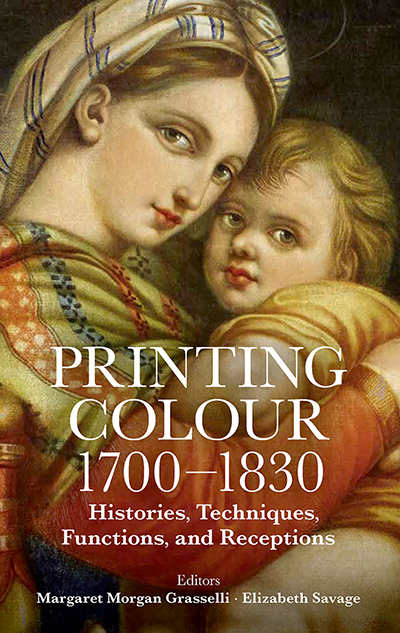
A magisterial, ambitious, and ground-breaking survey of its subject, this book is the sequel to Printing Colour, 1400–1700, edited by Ad Stijnman and Elizabeth Savage, published in 2015. The new volume has necessarily a wider scope, addressing the various advances in printmaking and print publishing in this later period but also examining the application of color printing to products such as wallpaper, calico, and ceramics, consumer products generally not otherwise considered in traditional print scholarship. The emphasis throughout is on the means of printing color, with less attention to aesthetics, but it is clear from the twenty-eight essays here that color was to prove transformative in many applications of printing—notably in science (botany, anatomy), in decoration (book wrappers, wallpaper, designs for the decorative arts), in the reproduction of drawings and paintings, in illustration, and in commercial and promotional material. With plentiful judiciously chosen plates, the book is sumptuously illustrated and includes a valuable selection of details and magnifications to illuminate aspects of process, such as embossing, the fine dots of stipple engraving, the subtleties of à la poupée inking, or the physical character of pigment deposited by a wood block.
The editors are admirably clear in their introduction about their definition of “printed colour,” which includes color applied by hand to a printed outline and printing on colored papers; they also set out the factors underlying their chosen date span, ending at the point when the invention of mechanized chromolithography was beginning to supplant many of the preceding hand-press processes documented here, though several authors look beyond the terminal date of the title where appropriate for their subject. In their two opening chapters, the editors document in detail the tools, machines, and techniques of color printing and explore the science behind the formulation of printing inks (organic and synthetic) and the factors contributing to the character and durability of the coloring, as well as hazards such as toxicity. They also flag the continuity of practice, with many of the tools and techniques invented or refined in the long eighteenth century still in use today. These topics are referenced and expanded upon in a number of the following chapters.
The essays vary in scope. Some are broad surveys taking in the entire period, as in Rob Banham’s chapter on letterpress-printed ephemera, Julia Nurse’s writing on medical treatises, and Phillippa Mapes’s account of printed wallpaper in England; others are chapters tightly focused on the innovative contributions of individual artists and printers such as Elisha Kirkall, John Baptist Jackson, and William Blake. The origins of the essays are various: some derive from or expand on conference papers (including the conference organized by Elizabeth Savage in London in 2018) and exhibition projects; at least one appears to précis an author’s PhD thesis; some are demonstrably the fruits of single-minded, decades-long research or draw on years of specialist study and curatorial experience.
In a review of such an ambitious book, it is impossible to analyze every topic, so we have chosen to examine selected chapters, corresponding to our own interests and areas of expertise. Color had value in many fields, from architecture to cartography, but was perhaps nowhere more important than in scientific publications, as Ad Stijnman sets out in his wide-ranging overview looking at color-printed illustrations in European books and periodicals over the period 1700 to 1850. In botany, entomology, ornithology, and other fields of natural history, accurate coloring is fundamental to identification and classification, and in botany and mycology, for example, color can be a vital clue in distinguishing edible species from their poisonous look-alikes. In medical treatises, color could communicate valuable information: for example, colors might be used as a key to identify different functions of the body’s organs in a dissection view. A fine instance is J. C. Le Blon’s “Preparation of Dissected Human Male Genitalia” (1719) which was the first documented anatomical print to show the arteries in red and the veins in blue, a practice which was to become standard in the nineteenth century and which continues today. Julia Nurse demonstrates how color contributed to medicine when deployed as a diagnostic tool with a plate showing diseases of the eye, where shades of red and pink indicate inflammation, swelling, and other impediments to healthy vision. She also establishes the importance, in the production of medical imagery, of a close collaboration between medical practitioners and the printers.
Geert-Jan Janse has made a close examination of the work of Anne Allen and Jean Pillement whose published designs, probably intended for embroidery, were instrumental in the development of à la poupée color printing in France. Several sets of the prints survive; Janse focuses on the so-called Doucet albums now in Paris and on several of the preparatory drawings which were auctioned at Christie’s, London, in 1981. Janse also illuminates in some detail the complex execution of these prints. Despite diligent research, he has been unable to uncover any new information about the accomplished Allen, but his exhaustive account of the Doucet prints has been welcomed by the curators of other collections which hold impressions of these prints.
Rob Banham’s account of letterpress-printed ephemera intended for a mass market, focused largely on playbills and lottery bills, is fascinating for the light it sheds on these precursors to the advertising posters which were to transform urban spaces from the late nineteenth century. As he points out, much printed matter—including tickets and souvenirs, as well as advertisements—was essentially transient and disposable, but it also needed to be eye-catching; these two factors encouraged the printers to experiment and innovate, adopting bold blocky lettering, and introducing color. Combinations of red and black were particularly effective and popular, but by the 1820s it was increasingly common for more colors to be used. What had been initiated largely by the lottery companies was taken up by those promoting London’s theaters, circuses, and pleasure gardens, with certain printers producing color-printed letterpress posters of unrivaled sophistication, before their methods were superseded by chromolithography.
It is this shift to commercial color printing that Michael Twyman, renowned expert on the history of lithography, explores in the book’s final chapters. Looking beyond the editors’ 1830 terminus, he covers George Baxter’s invention of the method of color printing, patented in 1835, which bears his name. Printed from metal relief blocks, these hugely popular pictorial prints were produced in many thousands of copies. Concurrently color lithography was advancing, with full-page illustrations in publications on travel and on architecture (including Owen Jones’s magnificent record of the ornament of the Alhambra) printed from multiple stones or from zinc plates, though both methods required some additional hand-coloring. These were not surpassed until Godefroy Englemann’s process of “chromolithographie,” which was granted an English patent in 1837, enabled consistently high-quality full-color printing, though commercial development and mechanization were not fully realized until the 1860s.
In her chapter on the English wallpaper trade, Phillippa Mapes gives a serviceable summary of wallpaper production over the long eighteenth century, as well as rehearsing information on printing techniques and business practices well-documented in other sources, all of which will certainly be familiar to wallpaper historians and curators, if not to print scholars. Curiously, despite the book’s title, Mapes has little to say about color per se. Beyond a reference to fashions in “patterned domestic goods moving towards lighter and more colourful styles” by mid-century, we learn very little here about customers’ choices of color or about the variety of colors available at different dates (such as the arsenical green invented in 1775 and later applied to wallpapers to sometimes noxious effect), nor does she address changing tastes and fashions in color. However, her examples are well-chosen for their vivid unfaded pigments (a useful corrective to the pervasive idea that historic wallpapers were subtly colored), and it is good to see the essay illustrated largely by fresh and unfamiliar papers, most from private collections.
In a book exploring technical invention and experiment, William Blake is a particularly interesting case study. In his excellent chapter on Blake’s color printing, Michael Phillips surveys the evidence provided by both laboratory analysis and the trial-and-error investigations into Blake’s methods made by a number of printmakers. These include Phillips himself, Robert Essick, Joseph Viscomi, W. Graham Robertson, S. W. Hayter, and Joan Miró.
While he confines himself mainly to the technical aspect, Phillips does situate Blake’s process and use of materials in the wider context of the metaphor universe Blake employs to embody his mythic system. He contrasts, for example, the transparency of the pure watercolor washes Blake used to color the Songs of Innocence with the opaque color applied to the Songs of Experience, saying of the metaphor they afford Blake: “Befitting the fallen world of Experience, these opaque colours precluded light from passing through and reflecting off the paper support.” Blake’s use of this polarity can be found in many passages but notably in Jerusalem, plate 14, where he contrasts the “translucent Wonder” of Los’s sons and daughters with the impervious “rocky form” of fallen Albion.
Much of Phillips’s chapter is devoted to the question of whether Blake could have achieved his final image in a single pass through the press or not. “Not” is Phillips’s conclusion, though this has been much debated by other scholars over the years. What does emerge, however, is that during the printing process, Blake would have been confronted with image states in which color dominates over form. Indeed, on the evidence of the Fitzwilliam Museum’s unfinished copy of plate 23 of The Book of Urizen, during this intermediate stage bounded form was almost completely absent.
Blake’s usual preference was for precise forms, bounded by a firm outline. Indeed, he had a horror of vague generalizations and of the “General Nature” advocated by Joshua Reynolds’s Discourses. Blake also insists, in opposition to the prevailing ideas of the Romantic Sublime, that spirits are not vague and formless but can be seen in minute particularity. We see this in his drawings in the Blake-Varley Sketchbook for example, where the visions are highly particularized. Phillips quotes Frederick Tatham, who may have actually witnessed Blake at work, describing how the inks for this intermediate stage were “blotted on.” Here the word “blot” is significant, for it had a very particular association at this time, and many artists would have been familiar with Alexander Cozens’s famous technique of suggesting landscapes from what we now might call Rorschach patterns: images hastily laid down without a willed plan. The same is true of the brilliant but, at that time, less well-known prints of the Dutchman Hercules Segers. Despite his opposition to vagueness, however, Blake seems to have accepted and appreciated these intermediate-stage “blots.” The reticulated “orange peel” textures they produced are very much still in evidence in many of the finished works and may have suggested details in the subsequent finishing process of overdrawing and outlining.
Blake’s overall metaphor for his printmaking technique was that the action of the etching acid, biting away the surfaces of his plates, mirrored the effects of his intellectual system, which had a similarly corrosive effect, turning all material events, historical and personal, into movements of the spirit. In general, Michael Phillips’s chapter serves to remind us that everything in Blake can be symbolic, even the printing and coloring methods he employed in transferring the work from out of his imagination and on to the paper during its birth into this world of generation.
Printing Colour, 1700–1830 will be warmly welcomed by researchers, collectors, and curators well beyond a narrowly defined field of print studies and will materially aid the identification and enhance the documentation of materials in libraries, archives, and museum collections. Equally, as the editors rightly conclude, despite its unprecedented range and its innovative interdisciplinary approach to the subject, the book will serve as a springboard for further research that might usefully expand the field and, one hopes, reach beyond Europe.