Whose Feet?
Robert N. Essick has been collecting and writing about Blake for over fifty years.
Jason Whittaker’s Jerusalem: Blake, Parry, and the Fight for Englishness is an important contribution to our understanding of Blake’s afterlife in the arts. In his first chapter, titled “And Did Those Feet?,” Whittaker considers the text of the lyric now known as “Jerusalem,” although Blake never gave it that title. As part of his discussion of the opening two lines of the poem—“And did those feet in ancient time. / Walk upon Englands mountains green:”—he finds that there are no written sources prior to Blake’s composition of the lyric to support the contention that the “feet” belong to Jesus. He does find ample textual precedent, however, for the belief that Jesus’s disciple Joseph of Arimathea visited Britain (36-39). Further, the inscription that Blake engraved c. 1820–25 on the second state of his separate plate, “JOSEPH / of Arimathea / among The Rocks of Albion,” clearly indicates knowledge of this legend. Whittaker concludes: Turning to the stanzas themselves, as noted above the opening lines are usually interpreted as a reference to Christ in England, but, as we have already seen, it is improbable—if not impossible—that Blake knew of that legend, as it was a later invention. Instead, the feet referred to are those of Joseph of Arimathea (45). I believe that this interpretation is wrong and that the usual reading of the opening lines is correct.
Let us turn to Blake’s relief-etched text of the lyric in the preface, present in two of the four known copies of Milton a Poem (illus. 1).
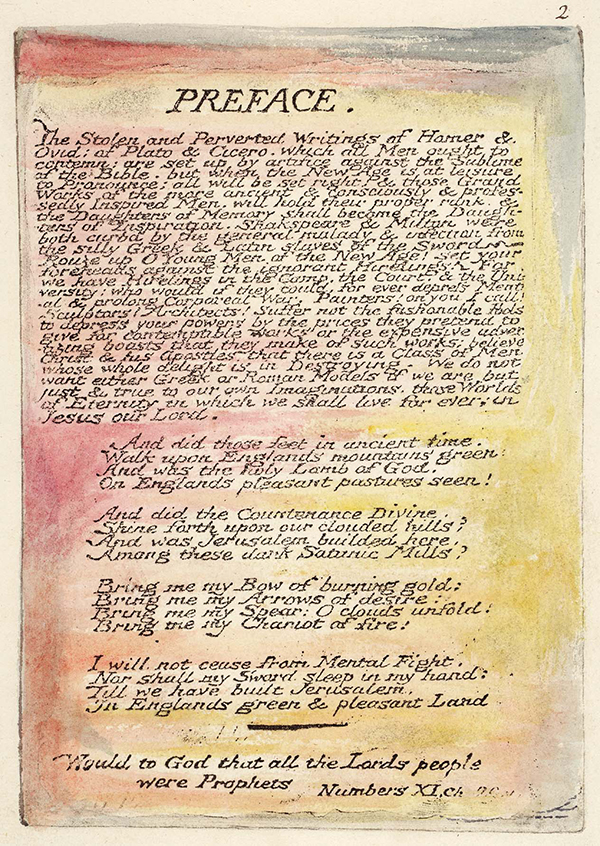
The third word in the poem’s first line, “those,” is usually a pronoun. The Oxford English Dictionary indicates that “those” can also be a demonstrative adjective, but Samuel Johnson’s Dictionary, from the first edition of 1755 through the ninth of 1806, labels the word solely as a pronoun. Pronouns need antecedents; where might we find one for “those feet”? The concluding three words of the final sentence in the prose section of the preface—indeed, the three words immediately preceding the poem—offer a proximate and grammatically correct answer: “Jesus our Lord.”
Where might we find confirmation that Blake knew of the legend that Jesus visited Britain? Once again, we have not far to seek. The third and fourth lines of the lyric read “And was the holy Lamb of God, / On Englands pleasant pastures seen!” “Lamb of God” could not possibly be a reference to Joseph of Arimathea, for the lamb is one of the more ancient and most frequently invoked metaphors for Christ in Christian art and literature, beginning with John the Baptist calling Jesus “the Lamb of God” in John 1.29. In the first quatrain, Blake is asking the same question twice, using different images (feet, lamb) for two consecutive references to the same figure.
Whittaker is probably correct in claiming that there are no written precedents for Blake’s reference to Christ’s visit to Britain; the editors of the Blake Trust volume devoted to Milton a Poem came to the same conclusion (214). This does not, however, preclude the possibility that the legend was part of oral tradition, an adjunct to the Joseph of Arimathea story circulating amongst dissenting Protestant groups in Blake’s time. Failing that origin, we may have to credit Blake with inventing the notion that the feet of the “holy Lamb” walked upon “Englands green & pleasant Land.”
Works Cited
Blake, William. Milton a Poem and the Final Illuminated Books. Edited by Robert N. Essick and Joseph Viscomi, William Blake Trust/Tate Gallery, 1993. Blake’s Illuminated Books, vol. 5, general editor David Bindman.
———. The William Blake Archive, edited by Robert N. Essick and Joseph Viscomi, blakearchive.org. Quotations from Blake’s writings and bibliographic information about them are based on texts in the archive; all four known copies of Milton a Poem are available.
Johnson, Samuel. A Dictionary of the English Language. Vol. 2, J. and P. Knapton et al., 1755. 9th ed., vol. 2, J. Johnson et al., 1806.
The Oxford English Dictionary. Vol. 11, Clarendon Press, 1933.
Whittaker, Jason. Jerusalem: Blake, Parry, and the Fight for Englishness. Oxford UP, 2022.